
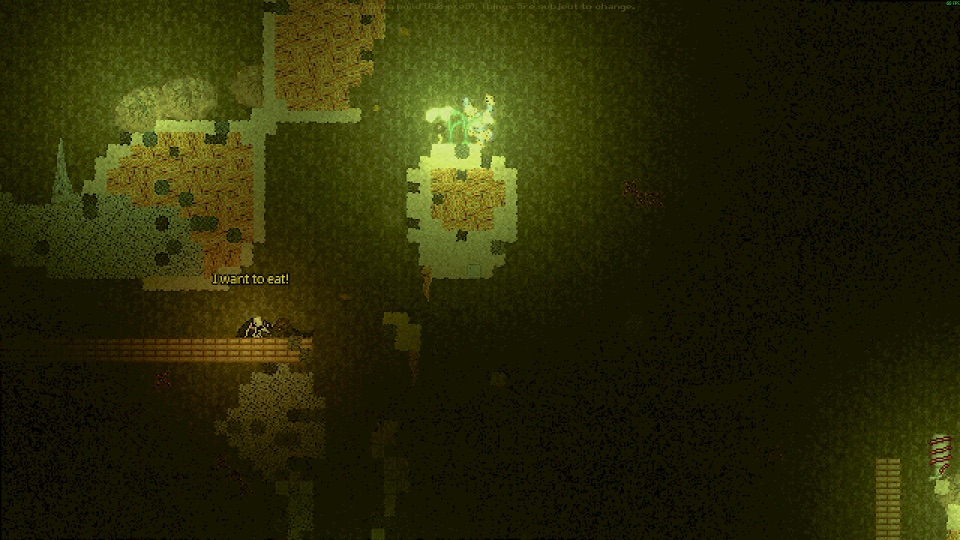
Official Steam screenshot · Game imagery © respective owners. Material credits.
Start with creature names supported by the game text
Shade Crawler, Cave Tick and Overgrown Tick appear in both the developer’s text and the collected community references. Thornback and Elder Thornback also overlap those sources. This corroborated set is a useful starting point when matching a name from a discussion with the creature information recorded for the game.
A name appearing in a reference does not establish every detail of its behavior or where it can be encountered in every build. Keep the creature’s identity separate from a claim about its health, detection range or a guaranteed way to defeat it. The supplied material supports these names without supplying a complete verified combat table for the full release.
Read the Thornback warnings as warnings
The developer’s English descriptions identify Thornbacks as aggressive. The Elder Thornback receives an especially strong warning, which is a reason to treat it seriously when interpreting the game’s own description. Those statements establish the tone and caution of the source without calculating a safe distance or promising a particular escape method.
A creature warning is different from a universal combat strategy. The supplied research does not establish exact health, AI range or a reliable sequence of attacks for every encounter. Use the description to recognize the threat, then avoid importing a precise tactic from a different game version or a modded recording as though it were a guaranteed vanilla mechanic.
Use the Cave Tick update to understand version differences
The developer’s 7.0 notes discuss Cave Tick bite balance. That confirms the creature is part of the versioned gameplay discussion and shows that the effects surrounding an encounter can change over time. It also gives a concrete example of why an old clip and a newer player report do not necessarily describe identical behavior.
When checking an enemy guide, look for the build it covers before adopting its expectations. A demonstration made before a balance update can still help identify a creature while being less useful for judging the consequences of its attacks. Keep recognition, description and numeric balance claims separate so that one useful part of an older source does not validate everything else it says.
Distinguish creatures from traps and hostile flora
The cave environment includes more than the creatures discussed in a bestiary. Traps and hostile flora belong in their own explanations rather than being added to a single unreliable enemy total. Keeping those categories distinct helps you understand whether a guide is discussing an animal-like encounter, an environmental obstacle or something introduced by a mod.
That separation also makes a player question more precise. A report about an unfamiliar hazard should describe what happened and the version involved, rather than assuming it must match one of the creature names listed above. The fact that two dangers can injure the character does not establish that they share the same behavior or should be handled with the same approach.
Identify demo, playtest and mod footage before using it
A recording can show ordinary demo play, a playtest, content introduced by a mod or a creature spawned through commands. Those situations do not establish the same kind of availability. Seeing a creature on screen therefore is not enough to conclude that an unmodified public-demo run can encounter it through normal progression.
The collected enemy video description includes Snowstrider, but the research does not establish its ordinary public-demo availability. It is consequently not promoted into the confirmed demo encounter list here. Apply the same check to any unfamiliar name in a video chapter: identify the source’s build and context before treating the appearance as a promise about your own run.
Prepare for injuries without assuming a universal counter
The game’s survival systems make wound care relevant to dangerous encounters. Ordinary Dressing slows bleeding and supports skin and fracture recovery, while infection and internal bleeding have distinct descriptions. Learning those systems before exploring gives you a practical foundation without claiming that a particular item neutralizes every creature or every kind of damage.
Use the tutorial to understand health-panel controls and the crafting menu before trying to infer an entire treatment plan from a creature’s appearance. When something goes wrong, inspect the actual injury and status warnings rather than assuming the enemy name tells the whole story. This keeps the response tied to the game’s displayed condition instead of an unsupported blanket strategy.
Choose a version-specific bestiary over an inflated total
The supplied community indexes disagree on parts of their naming and coverage. That is why this guide lists corroborated examples instead of claiming an exhaustive number of enemies at launch. A smaller list with clear evidence is more useful for identifying what a source actually supports than a total assembled from incompatible prototype, playtest and mod entries.
For a new enemy claim, check the name against developer text, identify the build and distinguish normal encounters from command demonstrations. For behavioral advice, prefer an explanation tied to that same version and situation. Keep the confirmed names as a reference point while leaving exact values and universal tactics out unless the matching game build establishes them.
Record an encounter without turning it into a universal rule
A helpful creature report begins with the name you can identify, the game version and the circumstances in which it appeared. Add whether the run used a mod or commands, since those contexts can affect what a recording establishes about ordinary availability. This makes a report useful for comparing experiences without assuming that every enemy-shaped object in a video belongs to the same public-demo encounter list.
If the name is uncertain, separate the observation from the identification rather than choosing a label from a long unverified list. The corroborated names above provide reference points, but they are not evidence that every unfamiliar hazard is one of those creatures. Describing the environment and visible situation gives another reader a better basis for comparison than attaching an exact health value or behavior that the checked sources do not support.
For injury advice after an encounter, describe the actual condition in the health panel. A known creature name does not replace the distinction between bleeding, infection, muscle damage and the other warnings the game displays. That keeps the practical question anchored to the injury system while the bestiary remains focused on supported identities, source quality and version differences.
Sources and version context
This guide uses research checked on November 8, 2026. Demo instructions, announced release content and community projects retain their separate version context. Follow the linked developer or project documentation for the source of each release or installation claim.